

CONTINUE READING

Enabling Innovation
‣
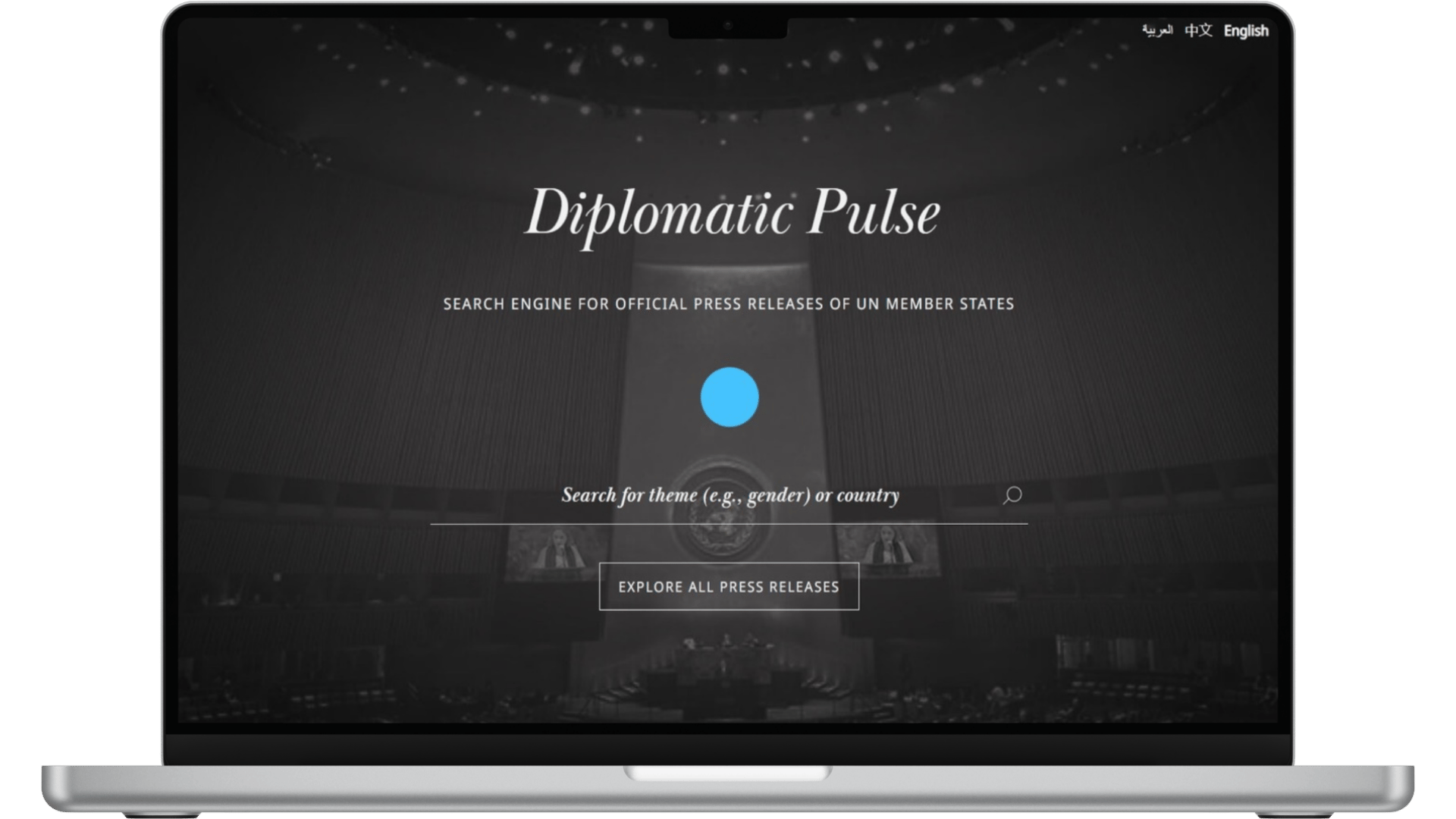
UN DPPA and the Qatar Computing Research Institute launched an updated version of Diplomatic Pulse. The platform aggregates official statements and press releases from all UN Member States and regional organisations in a single searchable interface and can now be integrated with any large language model, enhancing analytical capabilities.
#UN DPPA
‣
FAO published the Digital Agriculture and AI Innovation Roadmap to guide countries in scaling ethical and inclusive AI. Guidance on agricultural innovation and extension policies also supports strengthening innovation systems.
#FAO
‣
The UN Tech Bank for the Least Developed Countries and KAUST delivered a five-day training on AI, data literacy and ethical governance for thirty policymakers from least developed countries. Through practical sessions, participants explored AI applications for public service delivery and decision-making. A community of practice was launched to support continued collaboration and scaling of AI strategies.
#UN TECH BANK
Supporting Member States
Image: Diplomatic Pulse online interface
Strengthening Capacities Across the UN System
‣
What is UN 2.0? How does it apply to me? How can we make it real? Where do I start? These are common queries which the UNSSC Hub for UN Transformation often receives. Taking place in Nairobi in autumn, the five-day UN 2.0 Bootcamp invites UN personnel to explore UN 2.0 in practice: testing new ways of working, applying them to real challenges and shaping them to the realities of their context.
#UNSSC
‣
UNICC launched its AI Hub, a collaborative platform that offers advisory services, training, shared resources and a collaborative environment to support the development and deployment of AI initiatives across the UN system. It also provides an AI Sandbox to pilot and scale AI solutions, while promoting the reuse of trusted datasets and models and ensuring compliance with ethical and data protection standards.
#UNICC
‣
UN DPPA-DPO launched an AI fluency programme to support staff responsibly apply tools such as Copilot in daily work, training more than 175 personnel and piloting AI applications in two UN Missions (UNFICYP and MINUSCA).
#UN DPPA-DPO
‣
UN DPPA’s Innovation Cell has facilitated AI-powered Digital Dialogues across more than 20 contexts since 2021, cumulatively engaging over 14,000 people. Generative AI upgrades, including automated thematic clustering and summarisation, allow mediators to rapidly identify priorities while preserving participant anonymity, particularly important for women at risk of reprisals. In late 2025, the UN Mission in Libya (UNSMIL) used the platform to engage nearly 1,700 Libyans ahead of the Structured Dialogue. Findings, including that 86% of participants were ready to vote in elections if held immediately, were presented on the opening day of the Structured Dialogue and widely picked up by Libyan media.
#UN DPPA
‣
UNICRI published two AI literacy resources in collaboration with The Walt Disney Company: a factsheet for parents with recommendations and resources to guide their children in the responsible use of AI, and a short animation video for teens on how to responsibly interact with generative AI.
#UNICRI
‣
Under the AI4Citizens programme, UNICRI and BI Norwegian Business School, supported by the Research Council of Norway, released a Use Case Description and Analysis outlining how AI for crowd monitoring can help law enforcement officers identify threats to public safety more efficiently and support human operators in making quicker, more informed decisions while addressing ethical, societal, and human rights considerations.
#UNICRI
‣
UNITAR’s Artificial Intelligence for Learning Professionals course is designed for instructional designers, trainers and learning managers who want to work with AI to improve their learning design processes, from needs analysis through to content development and delivery. The self-paced course is a practical, human-centred learning experience built for real-world impact.
#UNITAR
‣
More than 15,000 UN personnel are actively using AI productivity tools rolled out by UN OICT to all UN Secretariat colleagues worldwide. Thousands are enrolled in a global training series for all personnel via virtual and in-person sessions.
#UN OICT
Video: This short animated video is part of the project “AI Literacy for Children: New Skills for a Changing World” launched by the UNICRI Centre for AI and Robotics, with the generous support of the Walt Disney Company.

‣
UN OHCHR is scaling Violet.AI, an AI-enabled system that integrates human rights data, open sources and partner datasets to detect conflict-related sexual violence risks earlier and support survivor-centred protection in conflict and fragile settings. Violet.AI is backed by the Norwegian Humanitarian Innovation Programme and Complex Risk Analytics Fund and run in partnership with UNIDIR and Insecurity Insight.
#UN OHCHR
#CRAF’D
#UNIDIR
‣
With support from UN Global Pulse, UN OHCHR is scaling the Civic Space Pulse, an internal real-time, AI-powered data classification and delivery system that tracks repression of protests, internet shutdowns and attacks on civic actors.
#UN GLOBAL PULSE
#UN OHCHR
‣
New data from SCOUT, WFP’s AI‑powered logistics optimisation tool, showed USD 6.2 million in savings over two years and a 10% reduction in planning costs in SCOUT-optimised operations. With projected annual savings of USD 25 million, the results show how AI‑driven logistic optimisation can significantly boost humanitarian efficiency at scale.
#WFP
‣
The IMF is exploring the use of AI to support access to official statistics through StatGPT. The tool translates natural-language questions into queries against official statistical sources to retrieve published figures from authoritative sources.
#IMF
‣
The IMF is using AI to make international statistical standards easier to navigate. Talk2Manuals, a public-facing chatbot, helps users explore frameworks such as the Balance of Payments Manual and System of National Accounts, providing citation-based responses with links to official guidance.
#IMF
‣
The Beyond Lab’s Futures Balance is an interactive AI-facilitated tool that helps policymakers move beyond short-term bias by assessing the long-term impacts and “spillover effects” of their policies and investments over time. The tool was developed in collaboration with the European Commission’s Joint Research Centre and TASC Platform and has been included as a key instrument for the European Union’s Intergenerational Fairness Strategy (IGF). It represents a meaningful step forward for anticipatory governance, evidence-based policymaking and the multilateral community’s commitments to ensuring that decisions taken today do not compromise the opportunities and wellbeing of future generations.
#BEYOND LAB
‣
EnvironmentGPT is UNEP’s first Retrieval-Augmented Generation (RAG) model designed to make trusted environmental knowledge more accessible, timely and usable. Built on curated environmental science publications, it allows users to query complex reports, synthesis findings, and extract insights to support policy and decision-making. By combining scientific rigour with AI capabilities, it demonstrates how digital innovation can strengthen evidence-based environmental governance while calculating and showcasing the environmental footprint of each prompt.
#UNEP
‣
ESCAP has developed the Meeting Intelligence Engine (EMIE), an AI-powered system that produces official meeting reports with precise references and video time stamps, cutting report production time from hours to about 20 minutes. EMIE also organises publicly available UN meeting discussions, references, and priorities into a searchable knowledge base, helping teams review outcomes, identify cross-cutting themes, prepare briefings on country positions, and support follow-up work linked to intergovernmental mandates.
#UN ESCAP
‣
ICAO developed an AI-based chat interface for staff to interact with documents, including working papers, minutes of meetings and decisions of its governing bodies. This was implemented using the Retrieval-Augmented Generation (RAG) technique which allows for scalability and sustainability of the AI application. The tool is currently being used to accelerate research (e.g. to determine when and why the ICAO Council may have adopted a specific standard). Once validated within ICAO, the tool could be used by Member States to enhance their understanding and implementation of the standards. The approach also lays the foundation for prototyping a fully agentic link between information between ICAO and its Member States.
#ICAO
Developing New Solutions
Video (Top): AI That Delivers More Food, Faster: Meet SCOUT
Image (Below): Violet AI, an AI-powered early warning system for conflict-related sexual violence (CRSV).
Video: The Futures Balance is an innovative, AI-facilitated tool that supports decision makers in the integration of long-term and cross-sectoral thinking at an early stage of policy design.
‣
The AI for Good Global Summit returns to Geneva from July 7-10 2026 and registration is now open. Organised by ITU in partnership with 50+ UN entities, this is the leading event to discover global AI innovations from across the UN.
#ITU
‣
In August 2025, the UN General Assembly established the first ever Independent International Scientific Panel on Artificial Intelligence by consensus resolution. Over 2,600 people from more than 140 countries applied for 40 seats, reflecting the urgency of ensuring every country has a voice in how AI is governed. The Panel, appointed by the General Assembly in February 2026, brings together experts from across disciplines and all five UN regions, with Maria Ressa, journalist, founder and Nobel Peace Prize Winner, and Yoshua Bengio, professor and founder, elected as co-chairs. The Panel’s mandate is to publish annual, evidence-based assessments of AI's opportunities, risks and impacts in the non-military domain, feeding directly into the Global Dialogues on Artificial Intelligence Governance, with the first taking place 6 and 7 July 2026 in Geneva. The Panel is supported by a secretariat that draws on UN system-wide capacities and is coordinated by Tech Envoy Amandeep Gill.
#UN EOSG
‣
UNU and the Government of Italy signed an agreement to establish a new research and training institute in Bologna's Technopole dedicated to big data and AI for sustainable development, giving the UN direct access to the data, computing power and algorithms needed to meaningfully understand AI.
#UNU
‣
The UN Environmental Assembly adopted a landmark resolution recognising AI as both an environmental opportunity and a responsibility. The resolution calls for international cooperation to assess and reduce AI’s environmental footprint — including energy, water, minerals and e-waste — while promoting AI applications that support climate action, biodiversity protection and pollution reduction.
#UNEP
‣
ITU approved the first international standard for assessing the environmental impact of AI systems. The standard provides a holistic framework covering direct and indirect impacts, assessment and mitigation strategies.
#ITU
‣
At Davos this year, UNU-CPR and ITU launched the AI for Good flagship report Unlocking AI's Potential to Serve Humanity spotlighting AI’s potential for inclusive development.
#UNU-CPR
#ITU
Video: AI for Good Summit 2026, Geneva (ITU)
Highlights across the UN
The UN is advancing AI governance, standards and applications through global coordination, new institutions and system-wide initiatives. Efforts span ethical oversight, environmental accountability and scalable tools across sectors while investing heavily in staff capacity, infrastructure and Member State support to ensure inclusive, responsible AI adoption.

LEVERAGING AI
